

Chapter Books for Boys
Young male protagonists pursue honor, justice, and adventure

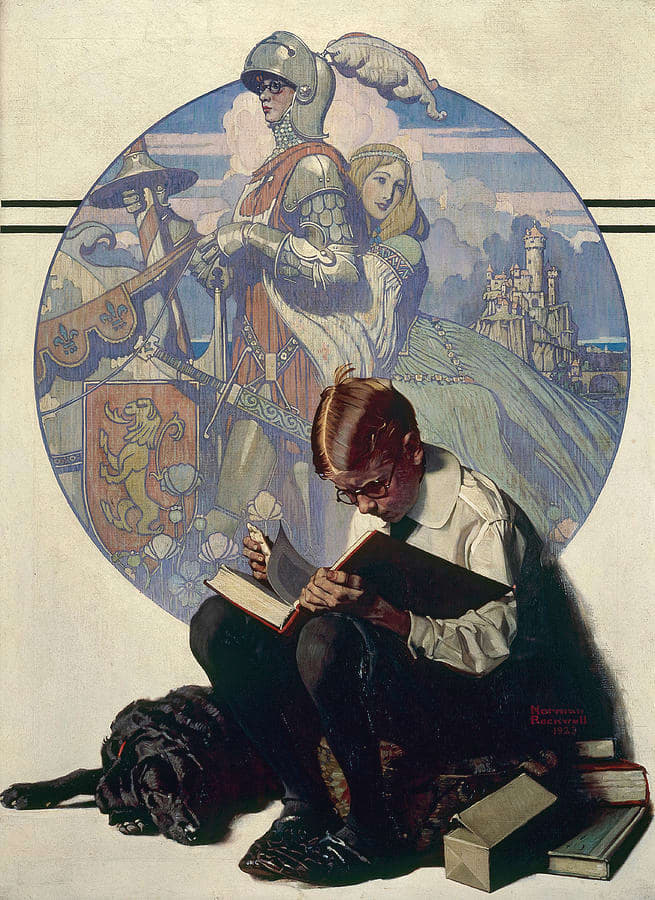
A good book is a good book is a good book. The best children’s literature is excellent for adults. The great ones featuring girls are great for boys, and vice versa.
But there is a place for boy-focused books—an important place, I think. Not because books about boyhood are exclusively for boys. But because boyhood is different from girlhood. Boys should see boyhood in literature. They should see what growing into manhood looks like, what maturity is, and (ideally) how a father interacts with his son.
So many books for youth have female protagonists. But excellent boys’ books are out there, too. And once I sat down to think of them, I soon had far too long a list. I chose to constrain myself to ten. Perhaps later I’ll publish a second installment.
For this list, I selected only books whose main character is a boy. There are of course many other books a boy should read—books with girls as the main character, or anthropomorphized animals, or adults. Many other books seem to speak in a special way to boys without having a main character at all, such as those by David Macaulay, whom I profiled a few months ago. But for this list, you’ll see only boys as protagonists, and only chapter books.
I also limited this list to books I would feel comfortable letting my son read on his own. So as much as I love Little Britches and have championed its reading in more than a few recent posts, I left it off this list because of occasional language. (Given the ages of our children right now, we read Little Britches and its sequels aloud to permit occasional editing.) Each family has different standards—and of course the age of your son and his maturity level matters greatly—but on this list, I consider every book appropriate for independent reading.
Here are ten top-tier chapter books featuring boys.
The Horse and His Boy, by C.S. Lewis
Every book in the Chronicles of Narnia deserves to be on this list, but I’ll single out one that tends to get less attention. Shasta’s life seems shaped by random, illogical hardship, but actually Aslan has put together all the pieces whose purpose will in time be revealed.
Shasta faces not just danger, but danger in the midst of tasks (such as horse-riding) that he has never been taught to do. He has to learn to persevere, to trust, to open himself to friendship, to interact with girls, and to tell the truth. Along the way, Shasta meets Corin, Rabadash, Edmund, and other male figures who show other forms of masculinity—some good, and some bad.
In the end, Shasta discovers his father and his surprising birthright and learns what it means to be a king—standards that our family takes for what it means to be a man. In Shasta’s father’s words:
For this is what it means to be a king: to be first in every desperate attack and last in every desperate retreat, and when there’s hunger in the land (as must now and then in bad years) to wear finer clothes and laugh louder over a scanty meal than any man in your land.
The Door in the Wall, by Marguerite de Angeli
Robin is nobility, and he knows the high duties expected from him—as well as the honor owed to him by others. But as the Black Death sweeps across Europe, he falls ill, losing not only his physical capability for the life he once envisioned, but the high status he once enjoyed. In this Newbery Medal winner, Robin learns humility and perseverance, as well as a newfound strength.
Though new walls may shut out old dreams, there is always a door for those who search.
The Sword in the Tree, by Clyde Robert Bulla
An early chapter book written at about a 1st-2nd grade level, The Sword in the Tree tells of a young boy who comes into the demands of a knightly gentleman much younger than expected. To save his father’s life, he must find King Arthur and prove himself a man.
Caleb’s Story, by Patricia MacLachlan
Caleb was quite young when Sarah, plain and tall, came to his family to be his new mother. Now he’s grown taller, big enough for his new little sister Cassie to look up to, and old enough to take on the task of writing down the family story.
In this third book of the Sarah, Plain and Tall series, we see the world through Caleb’s eyes and learn of old family wounds that he alone helps to mend.
The Sign of the Beaver, by Elizabeth George Speare
Matt and his father settle early in Maine, and once they’ve got a cabin built, Pa hikes back to town to bring the rest of the family. Matt is left alone far longer than he expects.
Matt finds he cannot quite fend for himself, and he learns wisdom, independence, self-reliance, and basic forest skills through a surprise friendship with a Native American boy. We see pros and cons of both types of civilization as both boys learn from each other.
Owls in the Family, by Farley Mowat
Farley can’t say no to any animal he finds, and that’s how he ends up with not one but two owls that, well, truly join the family. Dad is a little unsure about adding more creatures to the zoo quickly forming in the back yard, until he thinks of all the small creatures that owls eat. Maybe a couple of owls might decrease the population! That doesn’t happen, and Farley’s animals remain safe—from the owls, at least.
Mowat tells the true story of his childhood at a time when helicopter parenting just didn’t exist.
No matter how many times we’ve read this one, we still laugh uproariously each time.
Mountain Born, by Elizabeth Yates
Peter grows up with the family flock of sheep, and he learns manhood as his responsibilities increase. Peter learns to do a job well the first time, for much depends on one’s early work. He earns greater responsibility as he shows himself worthy.
Sometimes a book takes a thin slice of the world and beholds it in all its wondrous detail, almost as a slide under a microscope. So does this Newbery Honor book. It’s a short book that brings to life one livelihood in one time period, but does so in a way that brings home the lessons common to all mankind.
Farmer Boy, by Laura Ingalls Wilder
From the author of Little House on the Prairie, a look at boyhood on a farm. Laura wrote the story of her husband, Almanzo, as he worked and played and went to school in upstate New York.
Almanzo raises animals, hauls lumber, trains animals, and – spoiler alert – works hard to demonstrate the maturity his father requires before he can earn his own horse.
So many life lessons crop up naturally in the story—on honesty, frugality, perseverance, and more. A chapter on the county fair sets up a discussion between Almanzo and his father on the value of money—a passage so straightforward and yet insightful that my husband includes it each year in the high school economics class he teaches.
My Side of the Mountain, by Jean Craighead George
If a boy lived on his own in the forest, could he survive?
This is every boy’s dream, it seems, and My Side of the Mountain shows us a young man doing just that.
The first time I read this, I got angry that the boy had run away from home to do this and I worried that my kids would think I was legitimizing running away. Contrary to my fears, they didn’t even seem to notice how he got out there in the woods, but just drank up all the details on tree trunk houses and food foraging.
George wrote a trilogy, and all three books are worth reading.
The Swamp Robber, by Paul Hutchens (and the rest of The Sugar Creek Gang series)
Six boys who hike, farm, play baseball, solve mysteries, and revel in adventure—that’s the Sugar Creek Gang.
All 36 books are packed with adventure, nature lore, first aid tips, and also life lessons in maturity and character. Read them all or start in the middle—each book can stand alone if needed.
I read these over and over as a child, and when I reread a few books last week to check how accurate my memory was, I was surprised to see how much poetry and Scripture is woven throughout the books.
Bill and his friends quote Longfellow and Robert Louis Stevenson to each other, and they stop to pray and consider the Bible as naturally as they might pause to read a map.
Those are ten books that write of boyhood well. Happy reading!
This post contains affiliate links. If you make a purchase through my link, I may earn a small commission. This helps to support my family and my writing. Thank you!
Oh, these are good! You have listed some of my all-time favorites! I can't even tell you which of these is my favorite, because I love them all so much!!
Some for your list might be the books of G. A. Henty, who wrote 100% historical fiction, each volume of which has a teen boy for a protagonist.
Other books with boy-protagonists that come to mind....
* Lassie (okay, about a dog, but the background protagonist is the boy!)
* Old Yeller
* Johnny Tremain
* Treasures of the Snow
* Rufus M. (3rd book in the Moffats series)
* Where the Red Fern Grows
* Homer Price
* Henry Reed, Inc.
* Master Cornwall
* Books by Stephen Meader (one of my favorite authors for boys), like "River of the Wolves" and "Blueberry Mountain"
* The Cricket in Times Square
* Rascal
* Call It Courage
* A Single Shard
* Snow Treasure
Mmmmm.... so many good books. Thank you for your wonderful list, Rachelle!
What strikes me most about this list is that not one sits a boy down to teach him anything. My Side of the Mountain especially. The story supplies a hollowed tree and a fish hook and lets the maturity arrive sideways, while Sam is busy working out how to eat. That's the secret to it – books that contain lessons that never announce themselves are the only kind a boy will sit still for.