

Put Your John Hancock Here
Come sign the Declaration with us!

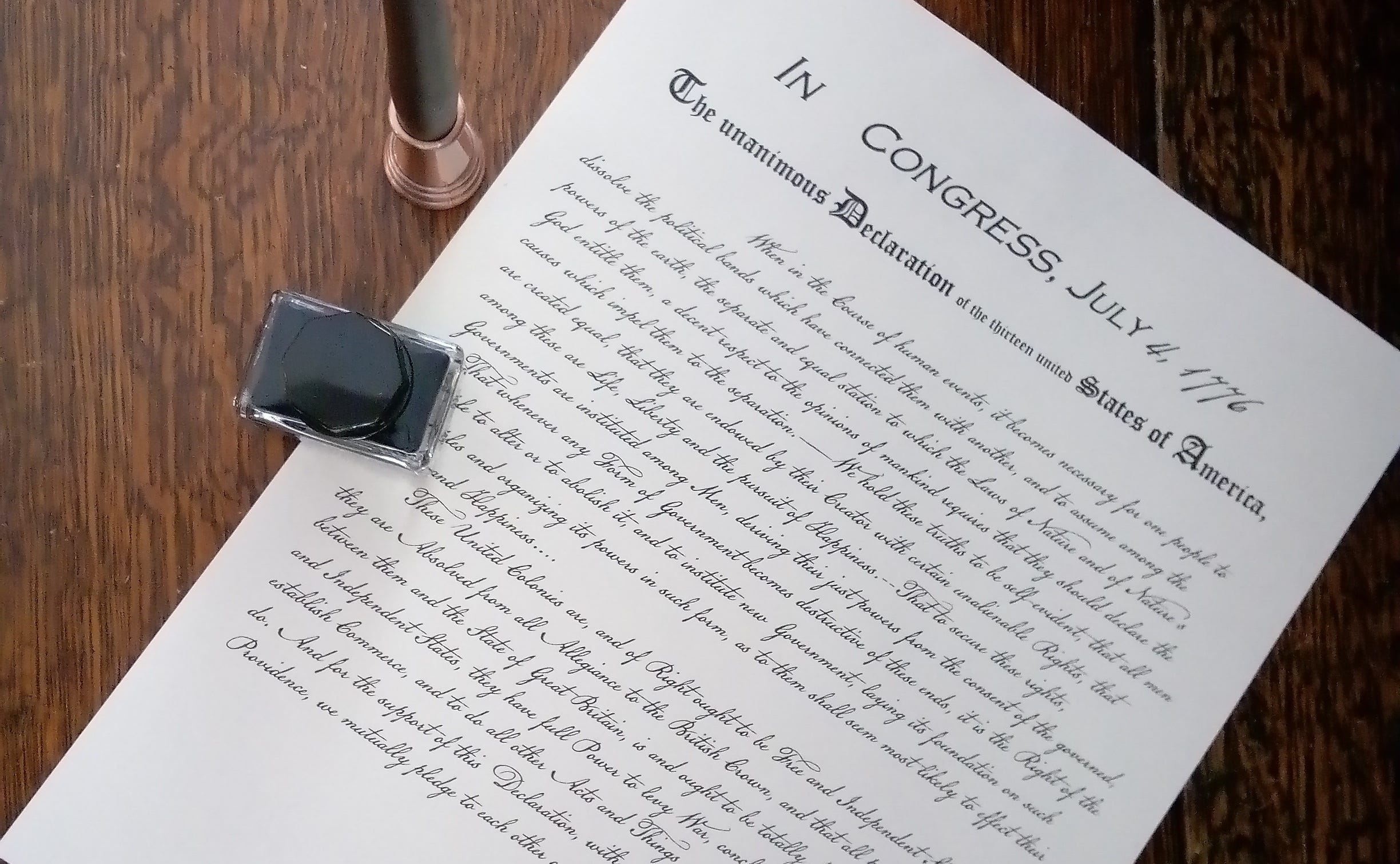
In this household, we relive historical and literary events. Had you come by on a certain spring day, you may have seen some children in blue wielding tin foil battle axes as Celtic warriors. Another day, you might find our backyard turned into Gettysburg. And a few times each year, elves, dwarves, and hobbits descend as we host family and friends for a Tolkien Recitation Night. (I’ll write more on that later this summer, in time for Hobbit Day in September.)
Perhaps you find this very exciting and inspiring, or maybe it’s not your thing. If so, just scroll straight down to the bottom of this post and see the booklist.
Last year, on its 810th anniversary, we “signed” the Magna Carta. (I say “signed,” because really King John affixed a royal stamp in wax.) My parents sourced some venison for a royal stew. We made trenchers (hard, flat bread used instead of plates), and there were no forks, only spoons. In true medieval fashion, all the guests had to bring their own knives. We may have bent this rule for two who forgot.
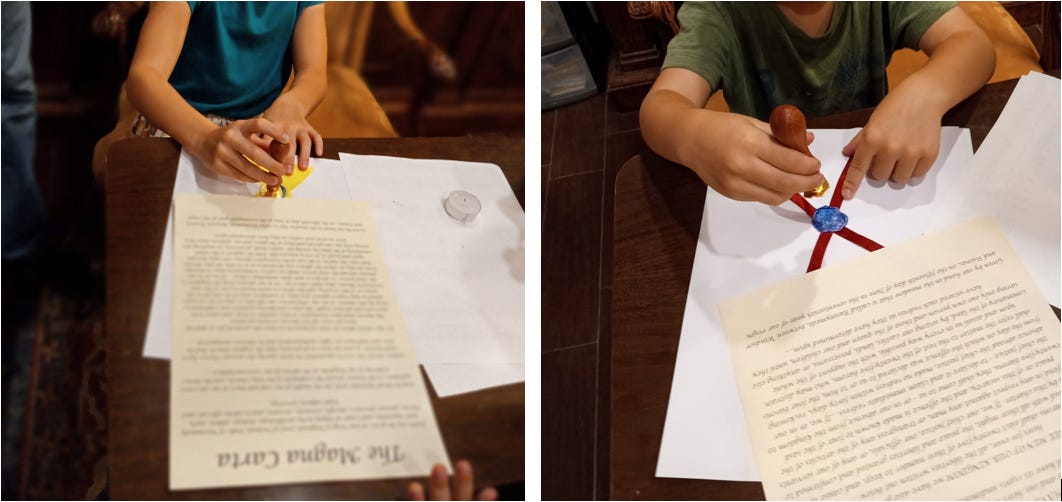
So, for the Semiquincentennial, of course we’re going to sign the Declaration of Independence.
My first task was to print a facsimile of the Declaration. But a 21x27 document reduced to 8.5x11 isn’t really readable, to say nothing of leaving space to sign.
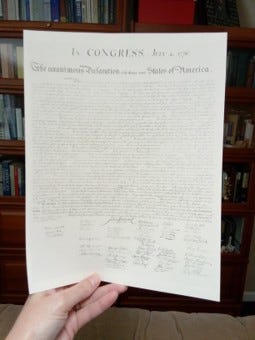
I searched around for something more suitable for our reenactment, and didn’t find quite what I wanted.
So I decided to make it. Imagine my delight to discover that some brilliant font-maker took the handwriting of Timothy Matlock (the scribe who wrote out the official copy of the Declaration) and turned it into a font!
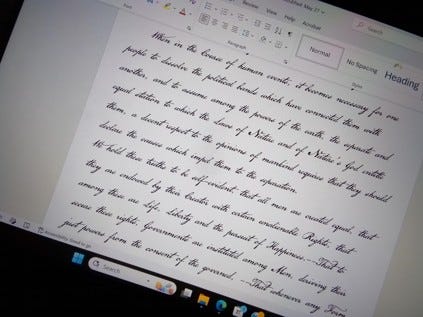
But even the best scribe writes less consistently than a font, and the Declaration has some different lettering at the top. So I fiddled around some more, and came up with this.
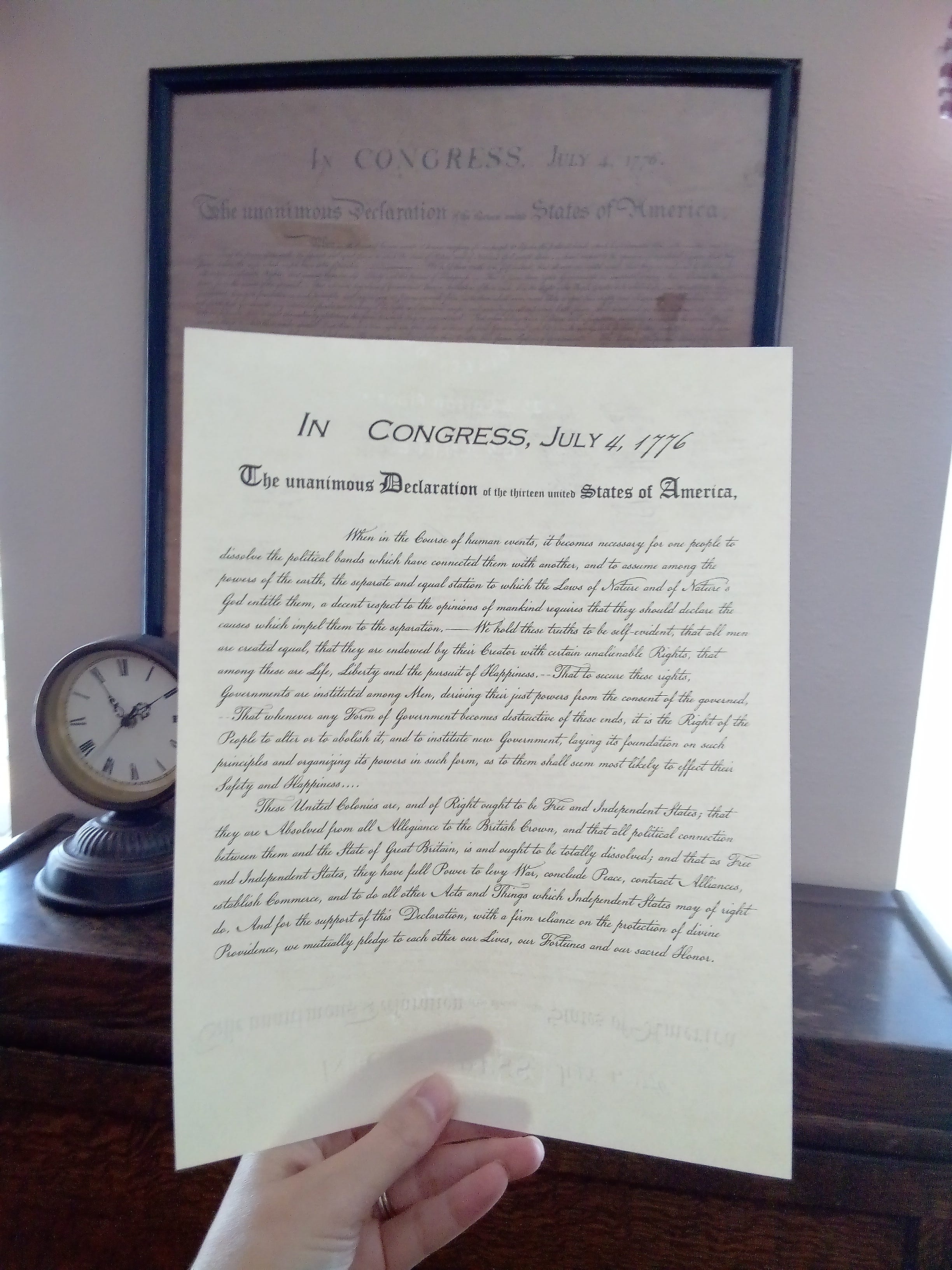
I put the famous first paragraph (“When in the course of human events…”) and the last half of the last paragraph, ending with “we mutually pledge to each other our Lives, our Fortunes, and our sacred Honor.” The heart of the Declaration is there. The writing is large enough that you can read it on standard printer paper. There’s room for your children (or you!) to sign your own name at the bottom.
So, join me in printing your own copy! If you want to go all out, get some yellowed paper, an inkwell and quill pen, and maybe even a tricorn hat.
Be sure to read the whole thing aloud. (See the full text at the National Archives.) In my experience, kids are surprisingly interested in “the long chain of abuses” and other parts that start to make adults’ eyes glaze over.
Then, whip out your quill and put your John Hancock at the bottom.

Books for the Fourth
A few months ago, in honor of America’s 250th birthday, I shared a long list of “Books that Love America.”
Today I’m adding a few more and excerpting others from that list that speak specifically to the Fourth of July.
The Fourth of July Story by Alice Dalgliesh, illustrated by Marie Nonnast
This is one of my favorite American picture books, and somehow I left it off my “Books that Love America” list! To remedy that mistake, The Fourth of July Story goes straight to the top of this list.
Dalgliesh brings the story of July 4th to life, showing us both the people and the ideas at work. This picture book is a treasure.
Will You Sign Here, John Hancock? by Jean Fritz
How did John Hancock come to have such a famous signature, and why did he sign anyway? Not shying away from vanity or other less virtuous motivations, Fritz gives a lively portrait of a famous early American whose grand spirit matched the greatness of his cause.
Written for about a second-grade reading level, Fritz’s book is great for early readers but also holds up well as a read-aloud.
Can’t You Make Them Behave, King George? by Jean Fritz
King George wasn’t expecting to be king, and he certainly wasn’t expecting his colony to break loose. Fritz gives us an interesting look at what was playing out on the other side of the Atlantic.
Like Will You Sign Here, John Hancock? a second grader could read this independently, or as always, Jean Fritz’s lively writing sustains being read aloud, too.
Thomas Jefferson, by Cheryl Harness
Cheryl Harness offers incredible paintings to accompany each biography she writes, and this is no exception. We look at Jefferson beyond his work on the Declaration. Harness references Sally Hemmings several times in a judicious manner.
How are you celebrating the Semiquincentennial?
This post contains affiliate links. I earn a small commission on purchases made through my links. Thank you for supporting my writing!
I LOVE this, thank you so much! My 5th graders and I will definitely be doing this when we get to the War for Independence.