

The Midnight Ride of Paul Revere
Poetry brings history to life.

“Listen, my children, and you shall hear of the midnight ride of Paul Revere.”
Those words came true for me recently, as my children cozied round and I read aloud from Henry Wadsworth Longfellow’s classic poem. It was the 18th of April, not of ’75, but 2026, 251 years to the day after Revere’s famous ride.
Like many, our family has been reading extra American history and folklore to celebrate the Semiquincentennial. We read the Declaration of Independence, including the long train of abuses, which my son found almost more interesting than the famous parts. We pulled out the biographies of founding fathers and dusted off some American classics. We even made it through the Constitution. Parts were a slog but the kids picked up far more than I expected and, to my great surprise, wanted to know in great detail how the electoral college worked. We tried Federalist 10, but I’m sorry, James Madison, you just aren’t great as a family read-aloud.
The Declaration of Independence was pretty exciting, not least of all because I’ve printed a copy that each kid is going to sign on July 4th. They know this is coming, so the anticipation builds. (We’re also cooking period food. At the end of this post I’ll share some recipes.)
But Paul Revere has been the most imagination-forming so far. The drama, the clear narrative arc, the petticoat-wrapped oars, the danger. The horse! The lanterns!
We read some biographies and other retellings of Paul Revere’s ride, but to be sure Longfellow’s poem is what sealed my kids’ interest. We enjoy memorizing long poems as a family, a few stanzas per person, so next up we’re tackling this one. But this famous poem is a dramatic ride for anyone, whether you’re naturally inclined toward poetry or not.
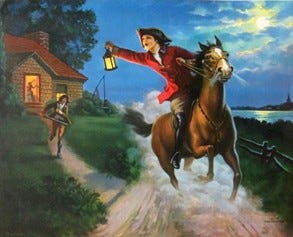
This weekend as we re-read the poem, my children and I, we were right there with Paul Revere. We watched him get up in the middle of the night, whispering to his friend about lantern codes, and saw him row across the Charles River past British warships. Historians aren’t sure if it was sexton Robert Newman or vestryman Captain John Pulling Jr. who hung the lanterns – Longfellow discreetly mentions merely “his friend” – but whoever it was, we climbed the North Church tower with him and saw him hang the famed two lanterns to warn that the British were coming by sea.
We heard the village clock strike 1 AM as Paul Revere rode into Lexington. Longfellow says “the fate of a nation was riding that night.” We felt that weight as we read.
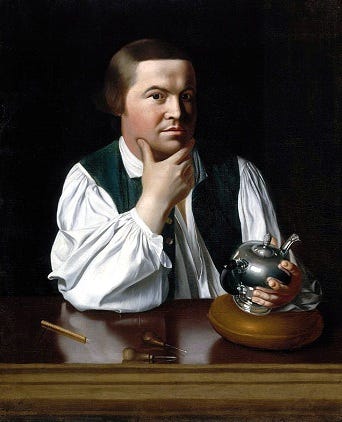
This is what poetry does. It transports you to another time and place, but then it also makes you feel the significance of what happened. The phrasing is different from normal speech, indicating that this is communicating something special. Rhythm and rhyme make the details stick in your mind, so that you more clearly remember not just the lanterns and the horse-riding, but the courage and the energy and the power. Not just of Paul Revere—though Longfellow lauds him greatly—but of all the brave men: “And one was safe and asleep in his bed / who at the bridge would be first to fall.”
Longfellow’s poem doesn’t purport to be scrupulous history. For one thing, Revere wasn’t the only rider that night. And he didn’t complete his trip. He got waylaid by British troops just outside of Lexington and spent much of the night in captivity. Longfellow may claim that “It was two by the village clock / When he came to the bridge in Concord town,” but Revere didn’t make it there. He was released on foot early the next morning just as the battle began.
Nor does Longfellow give us much context. He assumes we already know why the British were marching (to capture stockpiled American weapons) and he was confident that everyone knew the details of the battle. “You know the rest. In the books you have read / How the British regular fired and fled…” He doesn’t bear the historian’s burden to put it all plainly.
That’s why I’m a big fan of memorizing poetry and studying history. We need the actual facts of what happened, but we also need to grasp the spirit of what went on and why. We need to know the names of the actors but also who these men and women were and the spirits that animated them. We need poetry to communicate ethos and gravity. We need history to keep us grounded in truth.
We need poetry and history, hand in hand.
Books about Paul Revere
Here are some of the books and resources we’ve enjoyed on Paul Revere and his famous ride. I may earn a commission on purchases through my affiliate links.
The Midnight Ride of Paul Revere, by Henry Wadsworth Longfellow, illustrated by Christopher Bing (picture book)
I’m always a fan of a poem turned into a picture book. So long as the text is faithfully rendered, adding quality illustrations opens up the poem for tiny readers and enhances everyone else’s sense of what’s happening.
I like this edition because Bing not only illustrates beautifully but also includes facsimiles of key historical documents.
And Then What Happened, Paul Revere? by Jean Fritz (chapter book)
I’ve said before that Jean Fritz is the queen of biographies for children (though a few miss the mark). I’m close to having read all of her books, at which point I will write an author profile on her.
This is my favorite children’s biography of Revere. Don’t let the hokey cover illustration throw you off! Fritz captures Revere’s quick, eager spirit and still gives us all the facts (including setting Longfellow straight on a few counts). This is a short chapter book, written at about a 4th grade reading level.
Mr. Revere and I, by Robert Lawson (chapter book)
I have to include a few words about this book, because it appears on nearly every recommended reading list. This book is a decent read if you start about four chapters in. If you want just one book on Paul Revere, buy the Jean Fritz biography above.
Robert Lawson is a good author, and I like everything else I’ve read by him. But this is not his best. Lawson does give us a lively portrait of Revere and a good sense of the historical context surrounding his ride. But the early chapters consist of nothing more than ridicule of the British, who are presented as such bumbling idiots that an American victory seems hardly worth celebrating. Besides being unfair and untrue, we lose all sense of the significance of the American victory, which is, after all, what the book is supposed to be about.
Sleds on Boston Common, by Louise Borden, illustrated by Robert Andrew Parker (picture book)
In contrast to Mr. Revere and I, here we have quite a gentlemanly portrayal of the British, who though they are occupying Boston, nevertheless clear some space in their Boston Commons encampment to let the American children sled.
Nothing about Paul Revere here, but a nice look at the context in which he was riding.
“Concord Hymn” by Ralph Waldo Emerson
The phrase “the shot heard ‘round the world” originates here, in this excellent poem commemorating the battles of Lexington and Concord.
I’m not aware of a picture book version of this poem. Hark, publishers – please bring out a well-illustrated edition of this poem!
Costumes
We don’t always wear costumes (this is not my skillset), but usually my kids will come up with something, and in this case, we actually own a few relevant pieces, including a colonial dress sewed by my very talented sister.
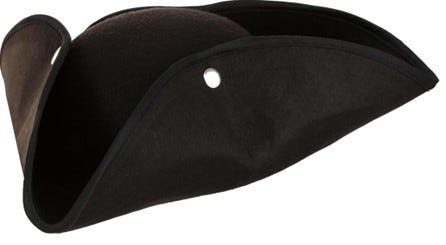
I highly recommend a tricorn hat! We’ve gotten much usage from ours, which will only get more wear leading up to July 4th.
Early American food
Next week our family is going to attempt to collectively recite the entirety of “Paul Revere’s Ride,” and in celebration we’ll be eating early American dishes.
Our family will be cooking from American Cookery, a cookbook by Amelia Simmons published in 1796 and archived online for free. We haven’t fully determined our menu yet, but here are a few tidbits of early American cooking advice:
“Garlicks, those used by the French, are better adapted to the uses of medicine than cookery.” Yikes.
On choosing carrots: “The yellow are better than the orange or the red.” Okay?
Some, ah, interesting recipes that we will not be eating
Turtle (must be butchered at 9 o’clock, apparently) – page 22 in the PDF
Foot pie – page 24
Tongue pie – page 25
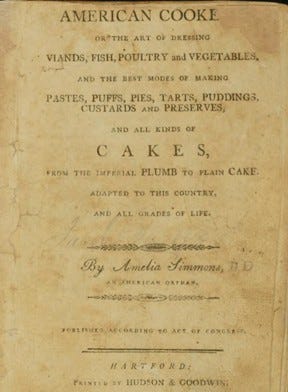
Publishing was evidently quite the raucous endeavor in the late 1700s. Our recipe author Amelia Simmons includes this note about a rogue editor who apparently doubled, halved, and other swapped ingredients in the cookbook’s first edition as some kind of mean joke.
The author of the American Cookery, not having an education sufficient to prepare the work for the press, the person that was employed by her and entrusted with the receipts, to prepare them for publication (with a design to impose on her, and injure the sale of the book) did omit several articles very essential in some of the receipts, and placed others in their stead, which were highly injurious to them, without her consent.
Fortunately we have the second edition to cook from.
If you enjoyed these ideas on bringing history to life, I’ll write on more historical events from time to time. Coming on May 5 is my larger booklist for America’s Semiquincentennial.
What are your favorite ways to bring history to life? What books do you recommend on Paul Revere or the American founding?
This was so fun! I love how you unpacked the power of poetry. And yes, while I love what he has to say, Madison is not read-aloud material.
Excellent commentary on the symbiotic relationship between history and poetry. Thank you; really enjoyed this!