

Ill-Fated Pastoral Visits in Children's Literature
Liniment cake and other unfortunate events

A year or two ago, my church instituted a new practice: each member of the church would receive a visit from one of the elders at least once a year. It would serve as a spiritual check-up while also providing an opportunity for us to ask questions and learn more about the life of the church.
It’s been a delightful practice, but I’ll admit to chuckling over its debut. Upon hearing the announcement, my mind went straight to some of the pastoral visits in children’s literature…which are almost uniformly funny if not downright slapstick.
A few weeks ago we had our official pastoral visit for the year. I’m glad to say no one ate liniment cake or suffered other outrages.
But to commemorate the occasion, all trivia questions today involve other pastoral visits that did not turn out quite so well. Perhaps you can think of others? Add them in the comments!
Easy
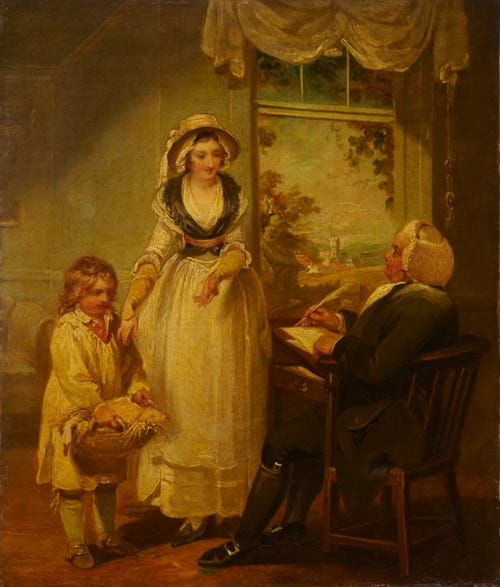
This redhead delights in a visit from the new minister and his wife and participates in all the preparations, particularly taking ownership of the cake. Unfortunately the bottle labeled “vanilla” is actually filled with anodyne liniment.
“Isn’t it nice to think that tomorrow is a new day with no mistakes in it yet?”
Medium
These kids are desperate to make their fortune—they’ll even attempt peddling sherry to a tee-totaling minister! (Technically, the kids visit the minister, I guess it’s the reverse of a pastoral visit?)
Hard
A whole menagerie lives at this boy’s home in Saskatchewan, and when the new minister stops by to warn against skipping Sunday School, an owl named Wol alights on his shoulder….and you can probably guess what happens next.
It’s a quick read, a book that particularly appeals to boys, and extra fun for all animal-lovers. (And did you catch the literary inspiration behind Wol’s name?)
Bonus
In “The Awful Reason of the Vicar’s Visit,” the Vicar of Chuntsey in Essex comes by to tell a surprising tale:
I have never been forcibly dressed up as an old woman and made to take part in a crime in the character of an old woman. Never once. My experience may be small. It may be insufficient. But it has never occurred to me before.
Then begins the mystery.
This not a children’s book per se, but I think it could work as a read-aloud for older children with strong vocabularies. It’s a quirky, delightful read I highly recommend!
What I’m Reading
I didn’t plan it this way, but in June I read a number of books that hold a special appeal for boys (though girls, including my own daughter, have appreciated them too). I may do a whole post on books for boys in the future. Would that be of interest?
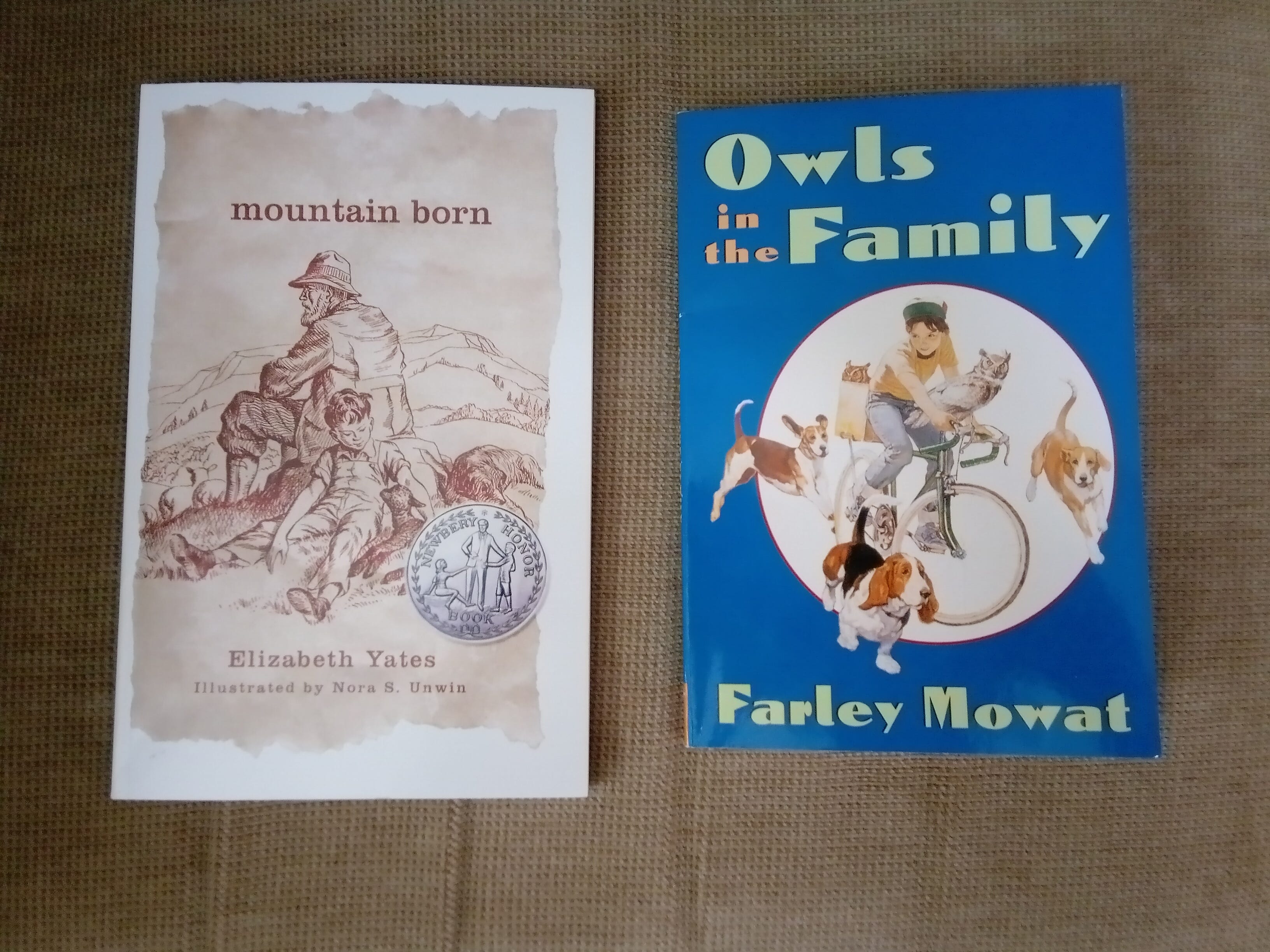
Mountain Born, by Elizabeth Yates
Peter grows up with the family flock of sheep, and he learns manhood as his responsibilities increase.
Sometimes a book takes a thin slice of the world and beholds it in all its wondrous detail, almost as a slide under a microscope. So does this Newbery Honor book. It’s a short book that brings to life one livelihood in one time period, but does so in a way that brings home the lessons common to all mankind.
Owls in the Family, by Farley Mowat
Farley can’t say no to any animal he finds, and that’s how he ends up with not one but two owls that, well, truly join the family. Mowat tells the true story of his childhood at a time when helicopter parenting just didn’t exist. No matter how many times we’ve read this one, we still laugh uproariously each time.
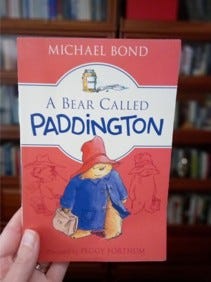
A Bear Called Paddington, by Michael Bond
Michael Bond didn’t envision Paddington as a children’s book, because like all great children’s books, it holds up for adults, too. He said,
It hadn’t been written with any particular age group in mind, which was fortunate, because until then I had always written for adults, and if I had consciously aimed at a young audience I might have “written down,” which is a bad idea. Anyway, I agree with Gertrude Stein: a book is a book is a book, and it should be enjoyable on all levels.
In part, he aimed at no particular age group because he wrote the book quite by accident. Paddington grew out of a morning writing exercise meant to get him warmed up for his real writing later.
The opening paragraph was simply an early-morning doodle brought on by the certain knowledge that if I didn’t put something down on the blank sheet of paper, in my typewriter, nobody else would.
Having written one paragraph, he found he had to keep going. Ten writing days later, he’d finished the book.
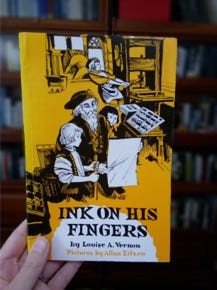
Ink on His Fingers, by Louise Vernon
A few months ago, I published a list of books that celebrate books. It’s been one of my most popular booklists (for obvious reasons!) and includes many of my own favorites.
But in that post, I crowdsourced a question. What’s a good book for children on Johann Gutenberg and the printing press? Everything I’d seen so far had been a disappointment.
Melisa Capistrant suggested I try Ink on His Fingers. As of last week, my children and I have now finished reading it. It’s the best chapter book on Gutenberg I’ve seen. Thank you, Melisa!
I think Ink on His Fingers was meant to be read independently, not aloud, as it includes a lot of dialogue set off only by spacing and punctuation visible to the eye but harder to hear. That said, I did read it aloud, and my children loved it and kept asking for more.
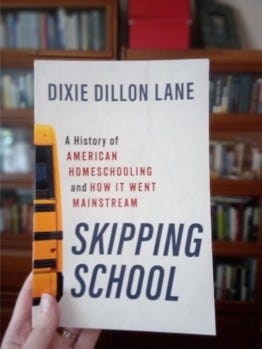
Skipping School: A History of American Homeschooling and How It Went Mainstream, by Dixie Dillon Lane
I’ve been looking forward to this new release for months! Finally, homeschooling gets a historian’s treatment by a historian who also homeschools.
Often, when I read articles on homeschooling, they’re written from the outside looking in, with an attitude of “let’s see what strange things are going on in this alien world.” Lane says she set out to write a history of homeschooling that would be recognizable to homeschoolers. As a second-generation homeschooler myself, I’d say she succeeded.
I have a full review of Skipping School coming out later.
Make Way for Sam Houston, by Jean Fritz
Continuing on with my Jean Fritz reading: this one was again lively, fun, and informative. Like a few of Fritz’s other books, it touches (delicately!) on some heavy topics, including Houston’s repeated womanizing in the first half of his life.
Richard II, by William Shakespeare
Shakespeare is my Sunday afternoon read-aloud with my husband, and this year, we’re working our way through the history plays. (From time to time we also try to speed up to match the pace on Taylor D’Amico’s Shakespeare in a Year, though this month we did not succeed.)
So many famous Shakespearian lines come from Richard II, but the one that’s become my new almost-daily go-to is “thanks, the exchequer of the poor.”
Project Hail Mary, by Andy Weir
Science fiction is not my normal genre, but that’s why it can be good to join a book group and branch out!
I haven’t seen the movie, but the book felt to me a bit like reading a movie. The sentences set up a series of visual images in my mind, and some scenes seemed written for big screen action.
Overall I enjoyed the book, though this one asked me to suspend a little too much disbelief in places. I was happy with the ending, however!
What have you been reading in June?
This post contains affiliate links. If you make a purchase through my link, I earn a small commission at no extra cost to you. Thank you for supporting my writing!
I would love a list of books for boys! I have three 5½ and under, and they love to be read to, and pour over picture books!
I'm excited that you're reading my book, Rachelle! Looking forward to your review. I'm glad you are liking it so far!