

The Great American Picture Book Finals
Plus reflections on what I’ve been reading

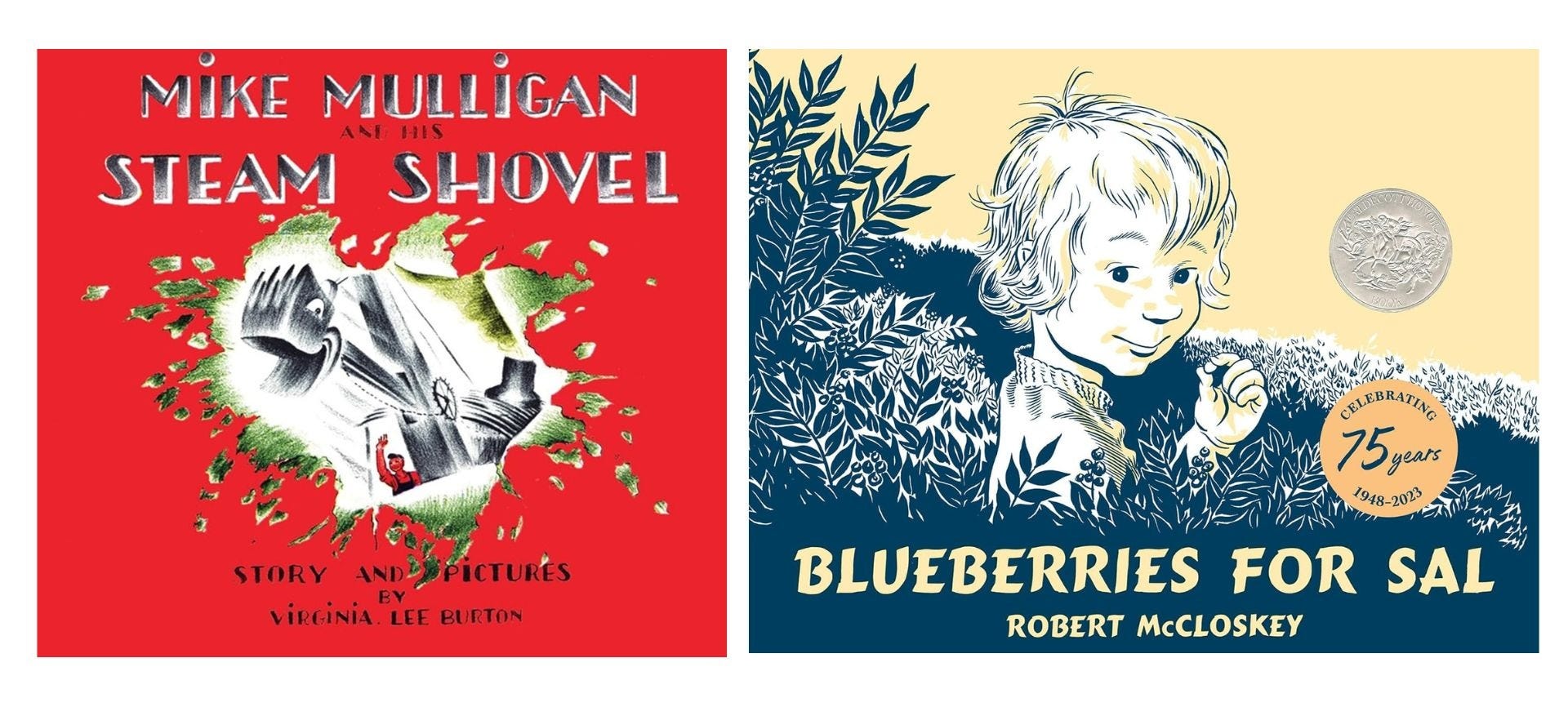
We’ve come to the final round. Two remaining books will battle it out for the title of The Great American Picture Book.
The matchup: Mike Mulligan and His Steam Shovel versus Blueberries for Sal.
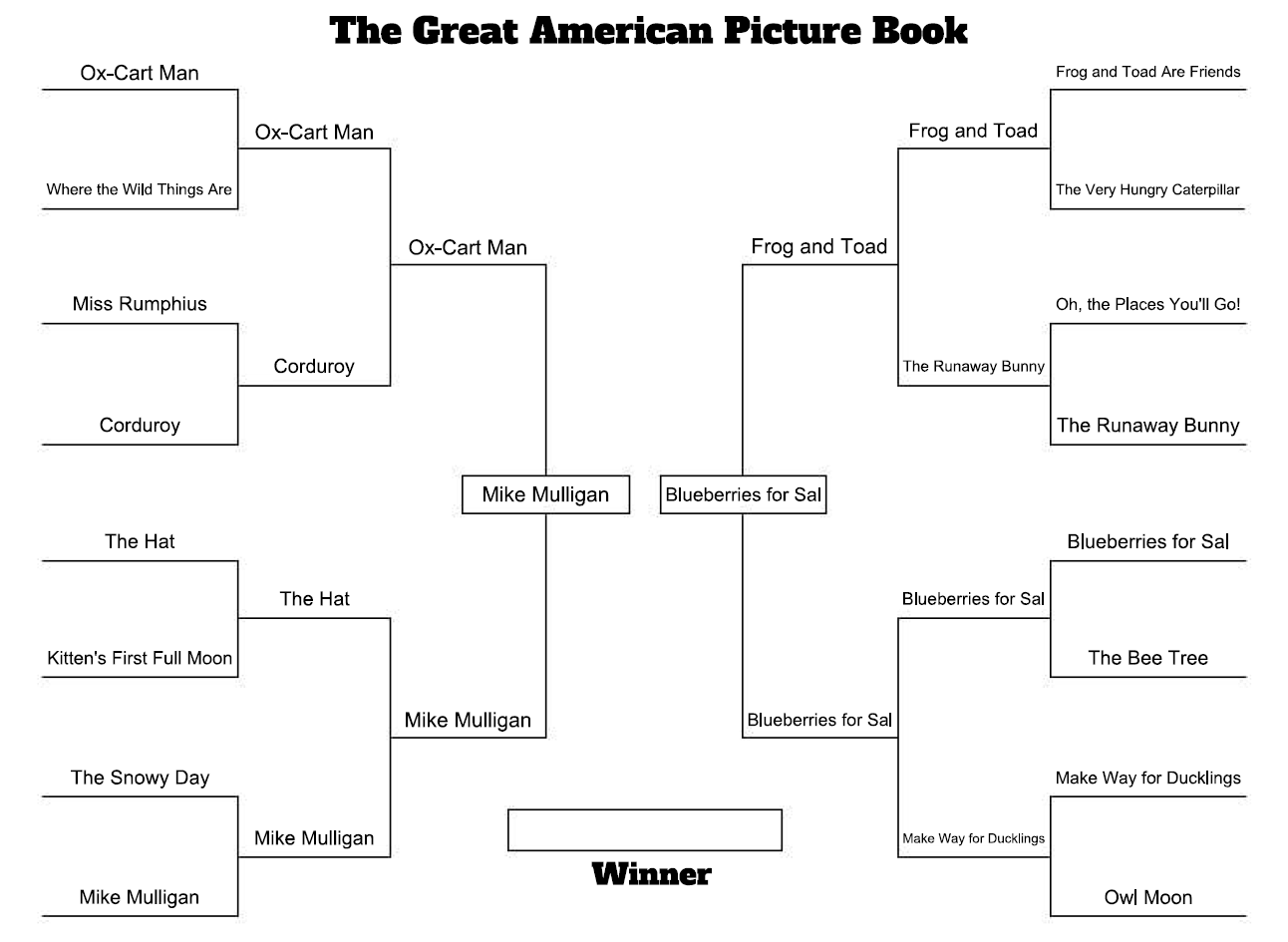
Down from sixteen to the final two. Mike Mulligan and Blueberries for Sal: How can one choose?
It’s no secret that I was sad to see Miss Rumphius voted out in the first round, and farewelling Ox-Cart Man in the semifinals was hard, too. Alas for Barbara Cooney!
But also, I love these final two books. And in a way, the match-up feels right.
We’ve got two variants on the American dream, with an honest look at their downsides, too.
The Great American Picture Book
In Mike Mulligan, Virginia Lee Burton opens with industrialization, progress, and the dream of ever-increasing material wellbeing. It’s great! Look at what hardworking men and their steam shovels can do! But there are costs, including the near loss of Mike’s beloved steam shovel, Mary Anne.
It takes a virtuous man like Mike Mulligan to know when to walk away, when to go back to the smalltown values that made the American dream possible in the first place.
But Mike Mulligan and His Steam Shovel isn’t a screed against cities, either. The little town of Popperville needs a little industrialization. After all, it would take a hundred men at least a week to dig the cellar of the new town hall, but Mike Mulligan and Mary Anne can do it in a day, so long as someone stays to watch.
The “stay and watch” theme is my favorite part of the book. That’s how it ought to be. A child should look over your shoulder, at least sometimes. We shouldn’t be totally atomized, segregated by age and vocation (necessary though that is sometimes). Children should be right there in the midst of society. And having a child looking over your shoulder should make you work a little harder and a little better.
Robert McCloskey zeroes in on this building block of American society: the family. Rather than a child’s look at an adult as in Mike Mulligan, Blueberries for Sal gives us a child’s look at another child. Sal and her mother are working together, picking blueberries for winter. Again, we’ve got a child right there in the midst of the work, watching and participating.
We’ve got the American themes of self-sufficiency, hard work, and planning ahead. But they’re softened by childhood. Sal is eating instead of saving, mostly playing instead of working, and wandering and getting lost instead of thinking ahead—and but for the scary mix-up with the bears, that’s just what she should be doing. Mother is very focused on storing food for winter (as she, a responsible mother, should be). And Sal is very focused on exploring the world (as she, a young child, should be).
But Sal is a little too exploratory, and Mother is a little too focused on her work, resulting in the famous parent exchange that makes up most of the plot. This is a universal tale of mothers and children, but in some ways it’s also a distinctly American tale. We Americans love to explore (sometimes a little too much) and we also love to work hard (also sometimes a little too much). Like Sal and her mother, we have to turn around and get back to the whole point of the work: family.
So which one is The Great American Picture Book? It’s hard to say, but the most American thing to do with the question is to vote on it.
What about these books do you love?
What I’ve been reading
May ended and with it, our homeschool year. Here’s what I read in the last month, besides, you know, piles of picture books and approximately two thousand renditions of Peter Rabbit. (Anyone else have a child that gets really, really into a book?)
Sons of Adam, Daughters of Eve: C.S. Lewis’s Images of Gender, by Joshua Herring
When Lucy steps through the wardrobe into Narnia and runs into the faun Mr. Tumnus, he immediately recognizes her as “a Daughter of Eve” – though he has never met a human, let alone a girl. How?
I appreciated this opportunity to think more seriously about how C.S. Lewis portrays sex and gender. Herring walks through Lewis’s fiction to piece it all together. I reviewed Herring’s book for First Things.
Christians Reading Classics, by Nadya Williams
Okay, I read this one in April, but my review of the book just came out yesterday at The Circe Institute blog. Christians Reading Classics tours more than a thousand years of ancient texts with an eye to how Christians can read even the pagans for virtue formation. Reading this made me want to get back into the originals, which is, after all, kind of the point of the book.
Harriet Beecher Stowe and the Beecher Preachers, by Jean Fritz
Brady, by Jean Fritz
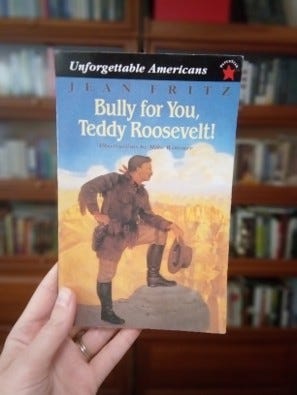
Bully for You, Teddy Roosevelt! by Jean Fritz
A trio of Jean Fritz books—some with my kids, some on my own to preview for them. Bully for You, Teddy Roosevelt! is the best of the three, a biography as fast-paced and exciting as its subject. I highly recommend it, though it does include some heavy moments, including the death of Teddy’s first wife.
I’ve said before that Jean Fritz is perhaps the best author of biographies for children, with a few exceptions. Her books are all over my America’s 250th list, in my list on “Paul Revere’s Ride,” and in my list of books that love books.
Fritz’s greats are truly great, and even her middling books are quite good. But when she misses (rare though this is), she misses badly. I’m working on an author profile on her, to come sometime this summer. None of the three books I read this month missed, though Harriet Beecher and the Beecher Preachers has some mature themes.
Ourselves, by Charlotte Mason
I had the privilege of reading through this volume alongside a group of women over the last ten months. We’ll meet tonight to discuss the last chapters and plan our schedule for next year. I’m so grateful for these women and the ways I’ve learned from and been encouraged by them.
I haven’t read all of Mason’s books, but so far, I wouldn’t rank this among Mason’s best work. Almost every other chapter I would exclaim to my husband, “C.S. Lewis said the same thing, only better!” Basically, if you read a lot of C.S. Lewis, you don’t need to read this one. But I still gleaned much wisdom and encouragement, and I added this convicting quote to my commonplace journal:
Great occasions do not come to us at any time of our lives; or if they do, they come in the guise of little matters every day. Let us be aware of this. The ‘great’ sphere for our Will is in ourselves. Our concern with life is to be fit, and according to our fitness come the occasions and the uses we shall be put to.
Swallows and Amazons, by Arthur Ransome
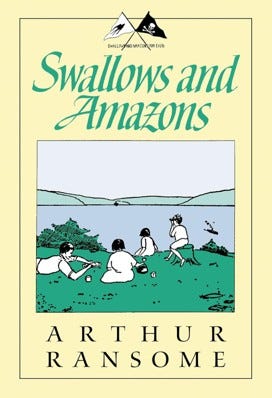
A bunch of kids messing about in boats and dead serious about it: this was our family read-aloud that we read seemingly nonstop on a recent camping trip. The book takes seriously all the things the kids are serious about. Plus the kids have incredible freedom and responsibility sailing around and camping on an island. Of course my kids loved it.
This was my first time through the book, and I got a little lost in all the boat terminology, but I did enjoy the book, and derived particular pleasure from the running subplot about the uncle writing a book.
“Captain Flint” (as the kids dub him) recently retired from world voyages to a houseboat, and this summer he doesn’t want to sail with the kids because he’s busy writing a book. “We’ve done everything we could to wake him up,” his niece complains. “We thought it wasn’t his fault to be writing a book, and that we would show him we didn’t think any worse of him for it.”
The kids keep pestering him to quit writing and come play. But he keeps writing, then loses his manuscript, and it’s the kids who rescue it. Captain Flint offers to buy an exotic animal as reward for one of the sailor children most responsible for his book’s recovery, setting up this remark on publishing:
I’ll see about it at once. There are monkeys nearer than Africa and I’m taking my book up to London now that I’ve got it again. I’ll go and look at monkeys by way of a change from publishers.
And by the end of the book, Captain Flint grumbles, “Don’t any of you start writing books. It isn’t worth it. This summer has been harder work for me than all the thirty years of knocking up and down that went before it.”
So, take it from Captain Flint. Maybe don’t write any more books.
Have you read Swallows and Amazons and what did you think of it?
And what are you reading right now?
This post contains Amazon affiliate links. If you make a purchase through my link, I earn a small commission (at no cost to you) that helps to support my writing. Thank you!
History is being made. Neck and neck voting at 51% for Mike Mulligan right now.
I am passionate about both, but I think Mike Mulligan embodies Americana a little better than Blueberries. You put the argument for both so well though.
I haven't read Swallows and Amazons, though my kids have, and I've meant to. We're about to begin Tom Sawyer together, and I'm bingeing Wodehouse and Golden Age mysteries this month. (For me personally, it's Blueberries for Sal and Frog & Toad forever and always, so lovely Mike never stood a chance for me. But the whole voting has been downright painful until now!)