

The Kindred Spirit of Boys
David Macaulay and His Books

Welcome to our first author profile! These posts offer the chance to explore a single author more fully. And because sometimes the same author writes both excellent and mediocre works, this series guards against the danger of assuming you’ll love everything by the author of your favorite book.
Let’s look at David Macaulay, the kindred spirit of boys everywhere.
Have you ever had a long conversation with an expert in some complicated field, who was so good at explaining things that you came away with a clear image of exactly what was going on and how it’s done? That’s a rare and amazing gift, and that’s what it’s like reading David Macaulay’s books.
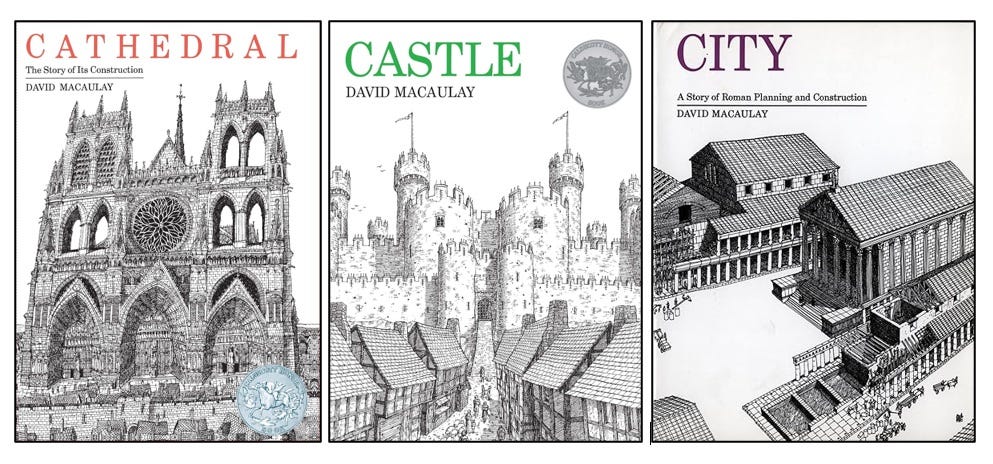
Macaulay takes readers inside the construction process of everything from cathedrals, pyramids, and the Empire State Building, to jet planes and even toilets. With pen-and-ink illustrations (and a few in full color), he draws with the precision of an engineer and the beauty of an artist. The text matches the quality of the illustrations.
Macaulay speaks straight to the heart of any boy who wants to build. (Girls, too.) Any kid who takes apart ballpoint pens and pries the wheels off of Hot Wheels cars will find a friend in Macaulay.
Macaulay’s unabashed fascination with how things work and his curiosity about the details—what exactly did a medieval pick-axe look like?—bring the answers to all the questions boys love to ask. (Usually, these are the questions I am least prepared to answer, so Macaulay’s books are a major help for me, too.)
When my son was four, we read City, and within a few weeks we had TinkerToy copies of the Roman tools he had seen. If you need a birthday gift or Easter basket filler for a boy between the ages of four and twelve (or even older), a David Macaulay book is a reliable choice.
I have read every book I mention here (with one partially-read exception noted below), as well as several others by Macaulay that I do not mention. However, I have not read every book he wrote.
Below I list his best and, although there are no major problems, I close with a few notes on the not-quite-as-good.
David Macaulay’s best books
As an Amazon Associate, I earn from qualifying purchases. If you buy a book based on my recommendation, I am grateful if you purchase through my link.
Castle (1977) (Amazon affiliate link)
Why were all those castles built? How were the sites chosen? Which features offered the best protection, and why did their design change over time? We follow the construction of one fictional castle based on many real ones.
Castle is the first in what became a series on individual engineering marvels. Each page has a paragraph or so of text, and detailed black-and-white drawings. My kids have enjoyed this from age four and onward, but it’s probably aimed at slightly older kids (I would say, age 7), and remains fascinating for adults.
Castle was later reissued in color, but I prefer the originals. You really focus on the mechanical prowess of these buildings when you’re not distracted by the colors.
Cathedral (1981) (Amazon affiliate link)
Who paid for those cathedrals? How did they get all those heavy stones up to the ceiling? How do flying buttresses hold their shape? Who made all that glass?
Cathedral, in particular, is my favorite by Macaulay. A Caldecott Honor Book, it’s one of his best.
Cathedral was also reissued in color. If you really want to know Cathedral up close, and examine Macaulay’s method, he wrote and illustrated a whole book just about the creation of Cathedral.
Pyramid (1982) (Amazon affiliate link)
Again, we walk through the construction process from start to finish. The basic concept of these books is the same, but the beauty is in the different types of buildings and the different people and tools that made them.
Our family reads Pyramid every time we cycle through ancient history, and many, many times in between.
City (1983) (Amazon affiliate link)
Macaulay imagines the building of a Roman city: acquiring and clearing the land, planning the grid, building the famed roads and aqueduct, choosing its first inhabitants, and eventually, after several hundred years of development, construction of huge temples and public buildings.
This book inspired one of my kids to build a TinkerToy workshop of replica Roman tools. You never know the capacity of a book to inspire.
The Way Things Work, cowritten with Neil Ardley (revised 2016) (Amazon affiliate link)
This mammoth book (which actually features mammoths demonstrating the scientific principles) attempts to cover how everything works. This is the book for a kid who likes to read the encyclopedia, or who wants to ask about every. single. thing.
Disclosure: I have read a lot of this, but not every single page.
Honorable mentions to Ship, Rome Antics (a bird’s-eye view of Rome), Mill, Underground (how do sewers, subways, foundations, and more get underground and work?), and Crossing on Time (ships with engines). I also give an honorable mention to Mosque for its excellent introduction to the architecture and construction process of these buildings, but I have to note that this book refers to “God,” which is confusing for kids who know there are many belief systems but only one true God. (Amazon affiliate links)
Macaulay’s best books for early readers
After the success of his early masterpieces, Macaulay started his own publishing group to issue early-reader books, often simplified versions of his bestsellers. Written at about a 1st or 2nd grade reading level, these aren’t as good as the originals, of course, but they pass Charlotte Mason’s rule of “no twaddle” and kids can read them on their own.
The How It Works Series
· Jet Plane (2015) (Amazon affiliate link)
· Toilet (2015) (Amazon affiliate link)
· Eye (2015) (Amazon affiliate link)
· Castle (2015) (Amazon affiliate link)
The not-quite-so-good
Every author has to have at least a few duds. Here are some I don’t find worthwhile.
Motel of the Mysteries (1979) (Amazon affiliate link)
Set two thousand years in the future, archaeologists are excavating the ancient and relatively unknown civilization that once resided in “Usa.” One archaeologist stumbles upon an untouched burial complex with the rare but once-standard marker that sealed a tomb from raiders: a small banner that reads “Do Not Disturb.”
Of course, this is just a motel, and the conclusions the archaeologist draws are wrong, sometimes hilariously so. It’s a good push to question how little we really known from archaeology, and it pokes fun at our own civilization as well.
But we get the point fairly quickly, and the story begins to drag. Tighten it up a little, Macaulay!
Young children may also be alarmed by the skeletons prominent on every page.
Great Moments in Architecture (1978) (Amazon affiliate link)
Macaulay draws famous bits of architecture, with “The Far Side”-style comments underneath. Okay, maybe it’s actually good but just not my style of humor.
Thanks for reading this first post in our Author Profiles series!
Let me know – have you read David Macaulay’s books before? What other authors would you like to see profiled here in the future?
And if you know someone else who loves to take things apart and build, would you share this post with them?
I absolutely loved these as a child.
Excellent choice. We own quite a few but my kids haven't gotten into them yet. Anyone who loves this author would enjoy Stephen Biesty as well, but he's harder to find affordably.